

Quartzite Vs Calacatta Marble Countertops | AI Room Planner
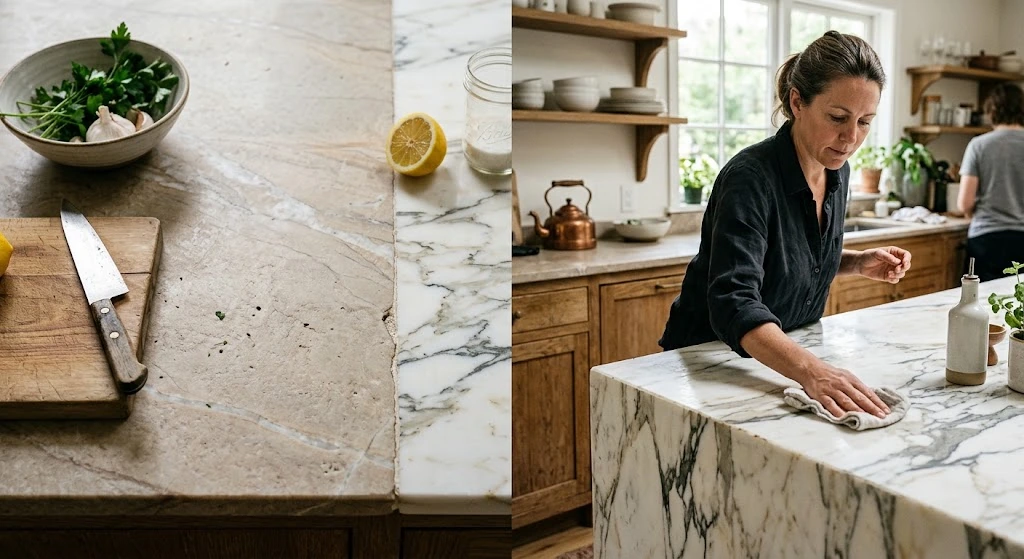
Natural Quartzite vs. Engineered Calacatta Quartz: Porosity, Citrus Etching Resistance, and Sealer Cycles
Natural Quartzite vs. Engineered Calacatta Quartz: Porosity, Citrus Etching Resistance, and Sealer Cycles
Quick Summary: If you are protecting a $7,000+ kitchen countertop investment, do not choose between “quartzite” and “quartz” from a showroom label alone. Verify the stone's mineral composition, water absorption, acid response, thermal requirements, and fabrication documentation before approving the slab. Genuine quartzite is dominated by quartz and typically has Mohs hardness around 7, while calcitic or dolomitic materials sold informally as “soft quartzite” can behave very differently under lemon juice. Engineered Calacatta quartz is generally low-absorption and visually consistent, but its polymer binder means direct exposure to very hot cookware requires manufacturer-specific precautions. Sintered compact stone adds a third option with extremely low water absorption and no resin binder.
| Material | Choose it when... | Verify first |
|---|---|---|
| Natural Quartzite | You want natural veining, high scratch resistance, and strong thermal performance | Mineral identity, acid response, absorption, and sealer requirements |
| Engineered Calacatta Quartz | You want predictable veining, low maintenance, and consistent fabrication behavior | Exact product heat guidance, resin composition, seams, and edge details |
| Sintered Compact Stone | You prioritize very low absorption, high chemical resistance, and minimal sealing | Product-specific fabrication limits, edge geometry, support, and thickness |
The practical decision is therefore not “natural versus engineered.” It is mineral chemistry versus polymer chemistry versus sintered ceramic-style chemistry. Those differences determine what happens when a cut lemon, red wine, wet towel, hot skillet, or daily cleaning routine meets the surface.
- Calcite Acid Etching vs. Polymer Resin Thermal Breakdown: Surface Chemistry
A genuine quartzite surface is primarily quartz-rich and mechanically hard, while carbonate stones can be chemically vulnerable to acids and engineered quartz relies on a resin binder that imposes different thermal constraints.
Quartzite, calcite, and dolomite are not interchangeable
The word quartzite should describe a metamorphic rock dominated by recrystallized quartz, not simply any pale stone with gray or gold veining.
That distinction matters because several natural stones can look remarkably similar in a polished slab:
True quartzite can contain approximately 90% or more quartz, depending on the deposit and classification.
Marble is dominated by carbonate minerals, commonly calcite and/or dolomite.
Dolomitic marble can be harder than calcitic marble but remains carbonate-based.
Some commercially marketed “soft quartzite” slabs can therefore behave more like marble than quartzite when exposed to acids.
A polished carbonate surface can show a chemical etch even when the stone has respectable scratch resistance.
Mohs hardness and acid resistance are separate properties.
Calcite is approximately Mohs 3, while quartz is approximately Mohs 7. A quartz-rich stone can therefore resist scratching substantially better than a calcite-rich stone. But a hardness number alone does not tell you whether lemon juice will attack the surface.
This is the first major verification principle:
Scratch resistance tells you about mechanical abrasion. Acid resistance tells you about mineral chemistry. Do not substitute one for the other.
Where the “soft quartzite” problem comes from
The phrase “soft quartzite” is often used conversationally in stone sales, but it is not a sufficiently precise mineralogical specification for a $7,000+ purchase.
A dolomitic marble may be noticeably harder than typical calcitic marble because dolomite is harder than calcite. That does not make it chemically equivalent to quartzite. Both remain carbonate-bearing materials capable of reacting with acids.
The practical risk is especially high when the slab has:
White or pale coloration.
Strong gray, gold, or taupe veining.
A glossy polished finish.
A showroom label using “quartzite” without a mineralogical report.
No documented absorption or acid-resistance data.
No matching slab sample available for destructive testing.
If a fabricator says a slab is “soft quartzite,” ask a more useful question:
“What is the documented mineral composition, and what acid-resistance test was performed on this exact slab?”
That question moves the discussion from marketing terminology to measurable performance.
Why acids attack carbonate surfaces
Lemon juice contains citric acid, and its pH is commonly around 2 to 2.5, although the exact value varies with concentration, fruit, dilution, and measurement conditions.
On a carbonate surface, acid can react with calcium- or magnesium-bearing minerals. The reaction can alter the polished surface and produce a duller patch.
The important visual distinction is that an acid etch is not necessarily a stain.
A stain involves material entering, adhering to, or discoloring the surface. An etch changes the surface itself. On a polished slab, that can appear as:
Loss of gloss.
A hazy circular patch.
A visibly different reflection.
A lighter or “frosted” area.
A patch that remains after the liquid has been completely cleaned away.
A penetrating sealer can reduce liquid absorption, but it does not convert calcite into quartz. Sealing and acid resistance are different performance mechanisms.
Engineered quartz uses a different failure mechanism
Engineered quartz countertops commonly combine a high mineral fraction with a polymer binder. For example, Caesarstone's published technical material describes quartz surfaces with up to approximately 90% quartz, with the balance including resin and pigments. Its technical data also reports very low water absorption for the specified product.
That composition gives engineered quartz an important maintenance advantage: the finished surface is generally nonporous enough that routine sealing is not the same maintenance requirement as it is for many natural stones.
But the resin changes the thermal equation.
Quartz mineral itself is highly heat resistant. The polymer-containing composite is the material you actually own, and the polymer component can be affected by concentrated heat, thermal gradients, or direct contact with hot cookware.
This is why a quartz countertop can be chemically resistant to many kitchen liquids while still requiring a trivet for a pan removed directly from a hot oven.
- Why the “30-Minute Lemon Test” Needs Context
A visible lemon-induced etch within roughly 30 minutes is plausible as a practical warning scenario on some polished calcitic surfaces, but there is no universal 30-minute failure threshold for every marble, quartzite, finish, concentration, or temperature.
The “30-minute lemon test” is useful only if it is treated as a field-warning concept rather than a standardized material specification.
What the 30-minute claim can and cannot mean
Under controlled conditions, concentrated acidic liquid can produce a visible change on susceptible polished carbonate stone within a relatively short period. Lemon juice around pH 2 to 2.5 is acidic enough that a polished calcite surface can show an obvious change during a short exposure.
But the actual reaction rate depends on multiple variables:
| Variable | Faster visible etching | Slower or less visible response |
|---|---|---|
| Mineral | High calcite content | Quartz-rich composition |
| Acid | Concentrated acidic liquid | Diluted liquid |
| Exposure | Continuous wet contact | Quickly wiped dry |
| Temperature | Warmer conditions | Cooler conditions |
| Surface | Highly polished | Honed or textured |
| Pressure | Liquid trapped under an object | Open-air droplet |
| Surface condition | Freshly polished | Existing wear or texture |
| Visual contrast | Dark or directional reflections | Matte surface hiding gloss loss |
A polished calcitic marble can therefore show a dramatic change relatively quickly, while a dolomitic material may respond more slowly, and a genuine dense quartzite should not be expected to exhibit classic calcite-style etching.
A rough 45-to-90-minute range can be used only as an illustrative field window for some slower-reacting dolomitic materials, not as a guaranteed threshold. There is no defensible universal statement that “dolomite takes 60 minutes” or that “quartzite survives 30 minutes.”
Why polished and honed finishes behave differently
Surface finish changes the visibility of an etch even when it does not completely change the underlying chemistry.
A polished surface has strong directional reflections. A small change in surface microtopography can therefore become highly visible because the damaged area reflects light differently from the surrounding slab.
A honed surface is already less reflective. The same chemical alteration may be less obvious to the eye.
That does not necessarily mean the honed stone is chemically immune.
This distinction matters in real kitchens because owners often judge damage by visibility:
“I cannot see an etch” does not automatically mean “no chemical reaction occurred.”
A practical acid comparison
| Surface/material | Likely acid behavior | What a buyer should do |
|---|---|---|
| Calcitic marble | High sensitivity to acidic liquids | Treat lemon, vinegar, wine, and acidic cleaners as etching risks |
| Dolomitic marble | Often slower than calcitic marble, but still carbonate-reactive | Require an actual sample test |
| True quartzite | Quartz-rich surface should not behave like calcite under ordinary lemon exposure | Verify that the slab is genuinely quartz-rich |
| Engineered quartz | Generally resistant to ordinary kitchen acids, subject to product documentation | Follow the manufacturer's chemical-cleaner guidance |
| Sintered compact stone | Very low absorption and strong chemical resistance in many products | Verify the exact product specification |
The important point is not whether lemon juice takes exactly 30, 45, or 90 minutes.
The useful question is:
Can the slab show an irreversible surface change under an acid exposure that realistically represents kitchen use?
If the answer is yes, you need to know that before approving fabrication.
Never perform hydrochloric acid testing casually
Hydrochloric acid is not a household countertop test.
If a slab yard or professional testing facility proposes an acid test, it should be controlled, documented, and performed according to an appropriate safety procedure. Do not pour hydrochloric acid onto a finished countertop, backsplash, sink cutout, or installed surface.
A small sample or remnant is the correct place to conduct destructive testing.
- 2026 Low-Porosity Sealers and Sintered Stone vs. Resin-Bound Quartz
Modern impregnating sealers can reduce liquid absorption in porous natural stone, but they do not eliminate carbonate acid sensitivity; sintered compact surfaces achieve low absorption through their material structure rather than a resin-based countertop binder.
The maintenance discussion has changed because stone treatment technology is better than the old “seal every six months no matter what” rule.
The role of modern impregnating sealers
A high-quality impregnating sealer penetrates accessible pores and reduces the rate at which liquids enter the stone.
That can improve resistance to:
Coffee staining.
Oil penetration.
Red wine staining.
Food-coloring liquids.
Water absorption.
But the sealer should not be described as an acid-proof coating unless the specific product documentation supports that claim.
A penetrating sealer does not create a thick plastic film that permanently isolates the stone from chemistry. It changes liquid transport into the pore network.
That means a sealed calcitic marble can still etch from lemon juice.
The stone's mineral chemistry remains underneath the treatment.
Why “reseal every six months” is too simplistic
A fixed six-month cycle is easy to remember but not necessarily technically correct for every slab.
The appropriate interval depends on:
Stone absorption.
Sealer chemistry.
Sealer application quality.
Kitchen usage.
Cleaning chemistry.
Traffic and abrasion.
Whether water still beads or darkens the stone.
Whether the fabricator applied a factory treatment.
Whether the stone has been mechanically refinished.
For many natural-stone installations, a 6-to-12-month inspection interval is more useful than an automatic resealing rule.
If a simple water test indicates that the surface is still resisting absorption, immediate resealing may not be necessary. If water rapidly darkens the stone or penetrates around an exposed edge, the surface deserves closer evaluation.
Sintered compact stone changes the maintenance model
Sintered compact surfaces such as Dekton are manufactured through a high-temperature, high-pressure process that produces a dense mineral surface without the resin-based composition typical of engineered quartz.
Cosentino's published technical data reports very low water absorption and open porosity for Dekton, with product-family values around 0.03% to 0.05% absorption in ASTM C97 data and 0.0% water absorption under ASTM C373 in the cited technical sheet. The same documentation identifies chemical and staining resistance testing.
Other Cosentino technical documentation reports open porosity around 0.2% and very low water absorption under the cited ISO method.
Those figures should be read as product-specific technical data, not a universal specification for every sintered slab sold by every manufacturer.
Engineered quartz, sintered stone, and natural quartzite
| Property | Natural Quartzite | Engineered Calacatta Quartz | Sintered Compact Stone |
|---|---|---|---|
| Main structure | Quartz-rich natural rock | Mineral aggregate + polymer binder | Dense sintered mineral surface |
| Typical scratch resistance | High | High | High |
| Liquid absorption | Deposit-dependent | Very low for many products | Extremely low for many products |
| Acid etching | Low if genuinely quartz-rich, but verify composition | Generally low under normal use | Generally very low |
| Resin binder | No | Yes | No polymer countertop binder |
| Routine sealing | Product-dependent | Usually not required | Usually not required |
| Direct hot cookware | Generally more tolerant | Requires manufacturer guidance | Product-specific, generally strong thermal performance |
| Visual variation | Natural | Controlled/manufactured | Manufactured |
The choice therefore depends on which failure mode you are most concerned about.
Natural quartzite requires the most attention to material identity and absorption.
Engineered quartz requires the most attention to heat management and product-specific fabrication instructions.
Sintered stone requires the most attention to fabrication, edge geometry, support, and installation requirements, because its low absorption does not make every installation detail irrelevant.
- Hardness, Porosity, Absorption and Heat Matrix: Quartzite vs. Engineered Quartz
Mohs hardness describes scratch resistance, while absorption, thermal expansion, binder chemistry, and thermal shock determine other aspects of countertop performance.
Hardness is only one line in the specification sheet
Quartz has a Mohs hardness of approximately 7.
Calcite is approximately 3.
That is a major difference, but Mohs hardness should never be treated as a complete countertop durability rating.
A stone can be hard but structurally unsuitable for a particular unsupported overhang.
A surface can be scratch resistant but vulnerable to acid etching.
A countertop can have low water absorption but still crack if fabrication and installation create an unfavorable thermal or mechanical condition.
The useful matrix is therefore multidimensional.
| Performance factor | Natural Quartzite | Engineered Calacatta Quartz | Sintered Compact Stone |
|---|---|---|---|
| Mohs reference | Quartz-rich areas around 7 | Quartz aggregate is hard | Mineral-dependent, generally high |
| Scratch resistance | High when genuinely quartz-rich | High | High |
| Water absorption | Varies by slab | Very low in many products | Extremely low in many products |
| Acid sensitivity | Usually low if quartz-rich | Generally low | Generally very low |
| Resin content | None as a natural-rock binder | Yes | No resin countertop binder |
| Heat behavior | Strong, but thermal shock still matters | Polymer binder requires heat protection | Strong thermal performance, product-specific |
| Sealing | May be required | Usually unnecessary | Usually unnecessary |
| Slab-to-slab variation | High | Low to moderate | Low to moderate |
| Verification priority | Mineralogy + absorption | Technical data + heat rules | Fabrication + support |
| ASTM C97/C97M is not the same as a kitchen “water drop test” |
The current ASTM C97/C97M standard covers absorption and bulk specific gravity for dimension stone and is designed to compare stone properties under a standardized laboratory method. ASTM's current listing identifies ASTM C97/C97M-26 as the active version as of September 2026.
That is valuable because it gives you a documented material property.
But a homeowner's water-drop test is not equivalent to ASTM laboratory testing.
The field test can answer:
“Does this exposed surface appear to absorb water rapidly?”
It cannot establish an ASTM absorption percentage.
Use the two levels appropriately:
Laboratory data: compare the material's documented absorption.
Field water test: check whether the actual slab behaves consistently with the seller's description.
Sample testing: investigate suspicious or disputed material.
Fabricator documentation: verify that the installed slab matches the tested product.
ASTM C373 and ISO 10545-3 are also important references for water absorption of ceramic and related tile materials. They should not be casually substituted for C97/C97M when discussing dimensional stone. Cosentino's technical documents use both ASTM and ISO/EN methods for different properties and products.
The 300°F question
The statement “engineered quartz fails above 300°F” is too broad to function as a reliable specification.
Likewise, the statement “quartz can handle anything from a hot pan” is also unsafe.
The actual thermal response depends on at least eight variables:
Resin formulation
Duration of exposure
Actual cookware surface temperature
Temperature gradient between cookware and countertop
Slab thickness
Edge geometry
Cutouts and openings
Support conditions and installation
Manufacturer guidance can also differ by product family and market.
For example, Caesarstone's published guidance states that quartz countertops are heat resistant but not heat proof and recommends protection from direct high heat. Its technical documentation also includes thermal-shock and high-temperature test results for a specified product specification.
That is why there is no defensible universal statement that every engineered quartz slab will yellow, blister, or fail at exactly 300°F.
Treat 300°F as a warning point for the risk discussion, not a universal material failure temperature.
What this means at the stove
For engineered quartz:
Use a trivet for cookware coming directly from an oven.
Do not assume a cast-iron pan is safe because the countertop itself feels cool nearby.
Do not place a hot baking sheet over a seam.
Avoid concentrated heat adjacent to sink or cooktop cutouts.
Follow the exact manufacturer's installation and care instructions.
For natural quartzite:
Direct heat is generally less concerning than for resin-bound quartz, but thermal shock can still matter.
A very hot object on a cold or mechanically stressed slab can produce localized stress.
Fabrication quality remains part of thermal durability.
For sintered compact stone:
High-temperature performance can be a major advantage.
Product-specific fabrication rules still matter.
Large unsupported spans, thin profiles, cutouts, and edge details require the fabricator's installation documentation.
- Slab-Yard Verification Protocol: On-Site Glass Scratch and Hydrochloric Acid Testing
A five-step slab-yard protocol can eliminate the most expensive identification errors before fabrication begins.
Do not treat the showroom sample as sufficient evidence. The exact slab you approve should be traceable to the technical information you receive.
Step 1: Photograph the slab identification
Before testing anything, photograph:
Slab tag.
Bundle number.
Supplier name.
Product name.
Lot or batch information.
Full slab.
Close-up of the selected area.
Record the exact slab number on your purchase documentation.
This matters because two slabs carrying the same marketing name can still differ visually, and natural stone can vary significantly within a quarry.
Step 2: Perform a controlled scratch-screening check
A quartz-rich surface should be substantially harder than ordinary glass.
A simple glass-scratch screen can therefore provide a screening signal, but it is not a formal Mohs test.
Do not drag a sharp tool across the finished display face.
Instead, ask the slab yard or fabricator to perform any destructive screening on an edge, remnant, or designated test area.
Interpret the result cautiously:
If glass scratches easily while the slab does not, that supports a hard mineral surface.
If the slab itself scratches readily, investigate the composition.
If the surface is coated, polished, or otherwise treated, the test may not represent the bulk stone.
A failed scratch screen is a reason to stop and investigate, not a reason to declare a mineral identity from one observation.
Step 3: Run a water absorption check on a sample area
Place a measured drop of clean water on an unsealed test area or remnant.
Record:
Initial appearance.
Darkening.
Time to visible absorption.
Time to recovery after wiping.
This is not ASTM C97/C97M.
It is a comparative field observation.
If the seller claims the stone is extremely low absorption but the sample rapidly darkens, ask for laboratory documentation before proceeding.
ASTM C97/C97M is specifically intended to determine absorption and bulk specific gravity of dimension stone, so a published test result is materially more useful than an unsupported verbal claim.
Step 4: Conduct an acid exposure test only on an appropriate sample
Use lemon juice or another representative acidic food liquid on a small remnant or designated test surface.
Document:
Acid concentration or source.
Approximate volume.
Exposure duration.
Ambient temperature.
Surface finish.
Before-and-after photographs.
Gloss change after cleaning.
A useful field sequence is:
Photograph the dry surface.
Apply the acidic liquid to a small marked area.
Check at 5, 15, 30, 60, and 90 minutes.
Wipe and neutralize according to the material-care instructions.
Photograph the surface under the same lighting.
Compare the reflection rather than only the color.
If the material is suspected to be carbonate-based, this test can reveal an etch even when the showroom label says “quartzite.”
Do not use concentrated hydrochloric acid as a casual consumer experiment. Any professional acid testing should be performed under controlled conditions and appropriate safety procedures.
Step 5: Request the technical sheet before fabrication
Before the purchase becomes irreversible, obtain the manufacturer's or quarry's documentation covering:
Water absorption.
Bulk specific gravity where applicable.
Chemical resistance.
Heat guidance.
Recommended cleaning chemistry.
Sealing requirements.
Fabrication limitations.
Thickness options.
Warranty exclusions.
If the seller cannot provide documentation for a material making a strong performance claim, treat the claim as unverified.
- Fifteen-Year Surface Economics: Re-Sealing Overhead vs. Thermal Repair Costs
A 15-year countertop comparison should include maintenance labor, resealing materials, refinishing, heat damage, fabrication constraints, and replacement risk rather than comparing slab prices alone.
A $7,000 countertop can easily become a $10,000-plus project once fabrication, sink cutouts, backsplashes, installation, plumbing adjustments, and replacement labor are included.
The surface therefore deserves lifecycle analysis.
Natural quartzite cost profile
A genuine quartzite can have excellent long-term durability.
Potential recurring costs include:
Initial sealing.
Periodic resealing.
Professional stain removal.
Honing or polishing after severe etching or abrasion.
Edge repair.
Replacement if a crack propagates through a critical area.
The largest unknown is often the slab itself.
A dense quartzite may need relatively little maintenance. A more absorptive slab may require significantly more attention.
This is why absorption data is economically important.
Engineered quartz cost profile
Engineered quartz generally reduces routine sealing requirements.
That can simplify ownership:
No routine impregnating-sealer cycle for most products.
Predictable cleaning.
Consistent surface appearance.
Less variation between slabs.
The economic risk moves toward thermal damage and repair.
A localized heat mark may sometimes be repairable, but the result depends on:
Damage depth.
Location.
Pattern.
Finish.
Accessibility.
Whether the damaged section can be refinished invisibly.
Whether replacement of the entire section is required.
The potential repair cost can therefore be disproportionate to the original cause.
Sintered stone cost profile
Sintered compact stone generally minimizes liquid absorption and routine sealing.
Its cost profile can instead be influenced by:
Specialized fabrication.
Tooling.
Edge complexity.
Transportation.
Slab thickness.
Cutout design.
Support requirements.
Replacement complexity.
A material can therefore be inexpensive to maintain but expensive to fabricate.
Illustrative 15-year model
| Cost category | Natural Quartzite | Engineered Calacatta Quartz | Sintered Compact Stone |
|---|---|---|---|
| Initial material | High variation | Moderate to high | Moderate to high |
| Sealing | Potential recurring cost | Usually minimal | Usually minimal |
| Acid-etch repair | Depends strongly on mineralogy | Usually low | Usually low |
| Heat-damage risk | Generally lower | Requires strict heat protection | Generally low, product-specific |
| Refinishing | Possible for many natural stones | Limited by product construction | Highly fabricator-dependent |
| Fabrication complexity | Moderate | Moderate | Can be high |
| Replacement complexity | High | High | High |
| 15-year uncertainty | Slab-specific | Product-specific thermal exposure | Fabrication-specific |
Do not assign a fake dollar figure to resealing without knowing the countertop's square footage, local labor rate, sealer product, and service requirements.
Instead, calculate:
15-year maintenance cost = initial treatment + scheduled inspections + actual resealing events + refinishing events + repair events
Then compare that against the material's purchase and fabrication price.
The cheapest slab is not necessarily the lowest-cost countertop.
- The Calacatta Name Does Not Identify the Material
“Calacatta” describes a visual language or product naming convention, not a single countertop chemistry.
This is one of the most important showroom distinctions.
A Calacatta-looking surface may be:
Natural marble.
Natural quartzite.
Dolomitic marble.
Engineered quartz.
Sintered compact stone.
Porcelain or ceramic slab.
The same white background with gray veining can therefore have radically different maintenance requirements.
Compare the chemistry, not the pattern
Imagine two slabs that look nearly identical:
Slab A: natural carbonate stone with dramatic gray veining.
Slab B: engineered quartz with printed or engineered Calacatta veining.
Under showroom lighting, they may appear interchangeable.
Under a cut lemon:
Slab A may develop an etch.
Slab B may remain visually unchanged under ordinary exposure.
Under a hot pan:
Slab A may tolerate heat better.
Slab B may require a trivet because of its polymer binder.
Under water absorption:
Slab A may require sealing.
Slab B may not.
The aesthetic decision can therefore be separated from the performance decision.
The three-question showroom test
Ask:
What is the exact material category?
What is the documented absorption percentage?
What does the manufacturer specify for acid and heat exposure?
If the answer to any of these is simply “It is a premium quartzite” or “It is a Calacatta surface,” keep investigating.
- Use AI Visualization as the Visual Verification Layer
A controlled AI visualization can compare two materials under identical room geometry and lighting, but it should answer “How will it look?” while physical testing answers “What will it do?”
This is where digital design can reduce the risk of making a costly material decision based on a small showroom sample.
The correct workflow is not:
Generate a pretty kitchen → choose the slab.
It is:
Physical verification → exact material selection → AI visualization → design comparison → final fabrication approval.
Step 1: Photograph the real kitchen correctly
For a useful room render, use:
The main 1x camera, not an ultrawide lens.
Camera distance of approximately 1.2 to 1.5 meters from the countertop.
At least 12 MP image resolution.
JPEG or PNG format.
Approximately 2 to 10 MB file size when practical.
Countertop, cabinet faces, backsplash, and floor junctions visible.
Camera held approximately level with the room's actual perspective.
No strong backlit window directly behind the counter.
Adequate ambient light.
The 1x camera matters because an ultrawide lens can exaggerate cabinet depth, countertop proportions, and corner geometry. An AI system can preserve those distorted proportions and make the rendered material look more dramatic than it would in the actual room.
Step 2: Render the same kitchen twice
Create two material variants while keeping everything else constant:
Variant A: verified natural quartzite.
Variant B: verified engineered Calacatta quartz.
Do not simultaneously change:
Cabinet color.
Backsplash.
Flooring.
Hardware.
Lighting.
Countertop edge.
Island dimensions.
Changing several variables makes the visual comparison unreliable.
Step 3: Compare the surface at 2700K and 4000K
Warm lighting around 2700K can make creamy whites and beige undertones appear more pronounced.
Neutral lighting around 4000K can reveal cooler gray or blue undertones.
Generate both lighting conditions.
Then compare:
Vein contrast.
Background warmth.
Reflection.
Visual weight.
Relationship to cabinet color.
Relationship to backsplash.
Apparent slab movement.
Perceived countertop brightness.
If you are also evaluating reflective finishes elsewhere in the room, the same principle applies: perceived brightness depends on surface reflectance and illumination, not color name alone. For a related discussion of how finish changes affect compact-space perception, see Matte vs. High-Gloss Tiles in Compact Bathrooms: Refraction Index, Water Spot Visibility, and Soap Scum Etching.
Step 4: Return to physical verification
AI visualization cannot determine:
Mineral composition.
Water absorption.
Acid resistance.
Resin formulation.
Thermal-shock performance.
Structural integrity.
Fabrication limitations.
It can, however, expose a visual issue before you buy the slab.
For example, if the AI comparison shows that a high-contrast quartzite overwhelms the existing cabinetry, you can reconsider the visual specification before paying for fabrication.
If both materials look appropriate, return to the slab-yard evidence.
For layout context, also review L-Shaped vs. U-Shaped Kitchen Layouts: Clearance Widths, Dead Corner Losses, and Ergonomic Flow before finalizing an island, peninsula, or major countertop change.
AI answers “How will it look?” Physical verification answers “What will it do?” Use both, but never substitute one for the other.
👉 Try Redesigning Your Kitchen for Free Online – No Sign-up Required
- Final Purchase Verification Sequence
The safest countertop purchase is one where the visual specification, physical slab, technical documentation, fabrication plan, and maintenance requirements all describe the same material.
Before releasing the final fabrication approval, complete this sequence.
Purchase checklist
Confirm the exact material category.
Record whether the slab is natural quartzite, marble, dolomitic marble, engineered quartz, porcelain, or sintered compact stone.
Record the slab identification.
Photograph the slab tag, supplier information, lot number, and full slab.
Request absorption data.
For natural dimension stone, ask for documented absorption information and identify the test method. ASTM C97/C97M is the relevant dimensional-stone reference for absorption and bulk specific gravity.
Separate hardness from acid resistance.
A stone that resists scratching is not automatically resistant to citrus acids.
Challenge the “soft quartzite” label.
Ask for mineralogical documentation if the material is described as unusually soft or marble-like.
Perform a controlled sample acid test.
Use lemon juice or another representative acidic liquid on a remnant or approved sample, not the finished countertop.
Document the 5-, 15-, 30-, 60-, and 90-minute observations.
Treat these as practical observation intervals, not universal failure thresholds.
Check the surface under reflected light.
Gloss change can reveal etching that a simple color comparison misses.
Record the exact sealer.
Include product name, application date, number of coats, and recommended maintenance interval.
Do not confuse sealing with acid protection.
An impregnating sealer can reduce absorption without making a carbonate stone acid-proof.
Obtain the exact engineered-quartz heat instructions.
Do not rely on a generic “300°F” rule.
Use trivets for direct high heat.
This is especially important for resin-bound engineered quartz.
Review thermal-risk locations.
Pay particular attention to cooktop cutouts, seams, sink openings, thin sections, and overhangs.
Confirm support conditions.
Ask the fabricator to document support requirements for islands, cantilevers, and large openings.
Confirm edge geometry.
Sharp internal corners can concentrate stress and should be fabricated according to the material's requirements.
Approve the slab layout before cutting.
Confirm vein direction, seam locations, sink position, cooktop position, and bookmatching.
Use the actual slab in the visual comparison.
Do not approve a dramatic digital pattern that does not correspond to the physical slab.
Check the kitchen under both warm and neutral lighting.
Compare approximately 2700K and 4000K conditions if the visual decision is close.
Keep the technical documents.
Store the slab identification, product data sheet, warranty, installation instructions, and care instructions with the purchase record.
FAQ
Is natural quartzite more durable than engineered Calacatta quartz?
“Durable” depends on the failure mode.
Genuine quartzite can offer excellent scratch resistance and strong thermal performance because it is a quartz-rich natural rock without a polymer countertop binder.
Engineered quartz can offer excellent stain resistance, low absorption, consistent appearance, and predictable fabrication characteristics.
If your primary concern is direct heat, resin chemistry matters. If your primary concern is staining and routine maintenance, low absorption matters. If your concern is acid etching, mineral composition matters.
There is no single durability number that resolves all three.
What is the best way to identify “soft quartzite”?
Start with documentation rather than the name.
Ask for:
Mineralogical identification.
Absorption data.
Acid-resistance information.
A remnant for destructive testing.
The quarry or supplier's technical description.
A glass-scratch screening test can provide a useful field signal, but it should not be treated as a mineralogical certification.
If the material reacts visibly to lemon juice like marble, investigate before accepting a “soft quartzite” label.
Can lemon juice really etch stone in 30 minutes?
Yes, a short exposure can plausibly produce visible etching on susceptible polished calcitic surfaces.
But 30 minutes is not a universal failure threshold.
The result depends on acid concentration, temperature, mineral composition, surface finish, exposure volume, and whether the liquid remains continuously wet.
A 30-minute observation is therefore useful as part of a controlled field test, not as a product specification.
Does a sealer stop quartzite from etching?
No.
A penetrating sealer primarily reduces liquid penetration and staining.
If a slab contains acid-sensitive carbonate minerals, sealing does not change those minerals into quartz. Lemon juice can still chemically alter the surface.
This is why a countertop can pass a water-absorption check and still fail an acid-exposure check.
Should I reseal natural quartzite every six months?
Not automatically.
A 6-to-12-month inspection cycle can be practical, but the actual resealing interval should depend on the slab's absorption, existing sealer, usage, cleaning practices, and manufacturer or fabricator guidance.
Test the surface and follow the product-specific sealer instructions rather than applying a calendar rule blindly.
Is engineered quartz safe above 300°F?
There is no defensible universal “300°F failure temperature” for every engineered quartz product.
Thermal response depends on the resin formulation, exposure duration, thermal gradient, slab geometry, thickness, cutouts, support, and cookware temperature.
Manufacturer guidance should control.
As a practical rule, use a trivet for cookware coming directly from an oven or high-heat cooking surface rather than trying to calculate whether a pan is exactly above or below a particular threshold.
Is sintered stone better than quartzite?
Sintered compact stone and quartzite solve different problems.
Sintered products can offer extremely low absorption and strong chemical resistance, while genuine quartzite provides natural mineral variation and high quartz-related hardness.
Sintered stone can also have stricter fabrication requirements depending on thickness and geometry.
Compare the technical data, fabrication method, appearance, and maintenance requirements rather than treating one category as universally superior.
Can AI tell me whether my countertop is real quartzite?
No.
AI image analysis can help identify visual patterns or compare how materials might look in a room, but it cannot reliably establish mineral composition, laboratory absorption, acid resistance, or resin chemistry from a photograph alone.
Use AI for visual decisions.
Use slab documentation and controlled physical testing for material-performance decisions.
Final Buying Verdict
The safest way to buy a premium countertop is to separate appearance, chemistry, and fabrication into three independent decisions.
For natural quartzite, verify that the material is actually quartz-rich rather than relying on “soft quartzite” as a showroom category. Check absorption and perform controlled acid testing on an appropriate sample when the material's chemistry is uncertain.
For engineered Calacatta quartz, take advantage of its low-absorption, consistent surface characteristics, but respect the polymer binder. Do not convert a vague 300°F warning into a fake universal failure temperature. Follow the exact manufacturer's heat guidance and use protection under direct high heat.
For sintered compact stone, consider the exceptionally low absorption and strong chemical resistance documented for many products, while giving fabrication and support details equal attention. Published technical sheets can provide materially useful data, including absorption and porosity measurements, but those figures belong to the specified product and test method.
Most importantly, do not let a beautiful Calacatta pattern substitute for a material specification.
Verify the slab. Test the chemistry. Document the heat requirements. Confirm the fabrication plan. Then use AI visualization to make sure the material you have verified is also the material you actually want to see every day.
Add a plain-language decision.
👉 Try Redesigning Your Room for Free Online – No Sign-up Required